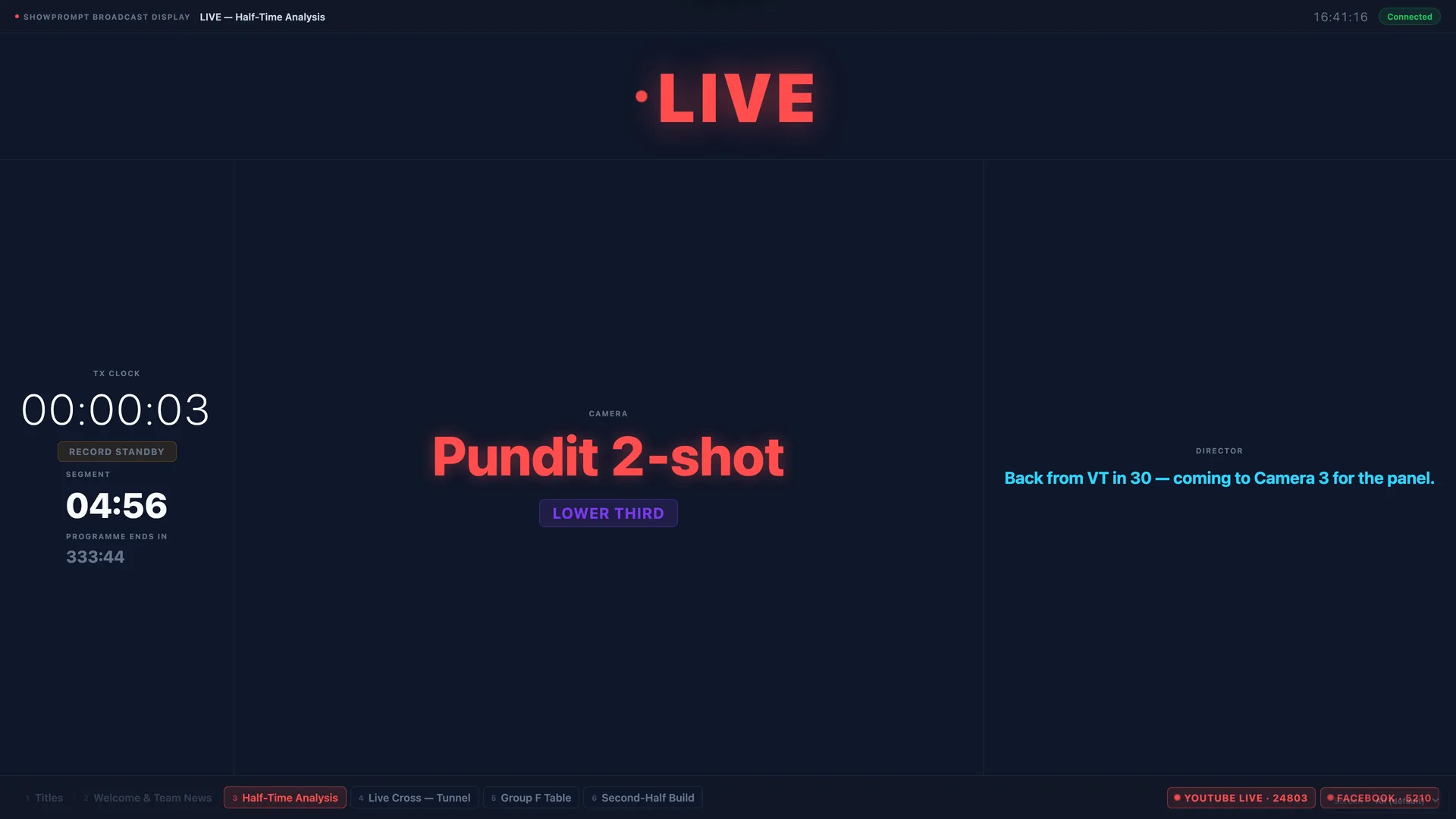
Everyone who has worked a live event has a war story. The keynote that ran 18 minutes long and ate the coffee break. The lighting cue that fired a scene early. The display that froze on a spinning wheel while 800 people watched. Most of these aren't freak accidents: they're predictable failures that a decent cue system quietly prevents.
Here are five of the most common live-show disasters, and the simple changes that stop them happening to you.
1. The speaker who won't stop talking
The single most common live-event problem is the overrun. A speaker ignores the polite hand-waving from the back of the room, and the whole schedule slips. The fix isn't a stricter chairperson — it's a clear, unmissable confidence monitor in their eyeline showing a countdown, with amber and red warnings as they approach zero. People respond to a number counting down far better than to a stage manager mouthing "wrap up". We go deeper on this in why presenters overrun.
2. The cue that fires at the wrong moment
Miscommunication between the operator and the crew is how cues land early or late. "Standby LX 14… and… go" works on cans, but the moment you have sound, lighting, video and stage all reacting to the same beat, verbal cues drift. A grouped cue system (where one GO fires every department's cue together) removes the ambiguity. Everyone sees the same standby and the same go at the same instant.
3. The screen that goes blank
Cloud-based tools fail the moment the venue Wi-Fi drops, and venue Wi-Fi will drop. If your timer or cue screen lives on someone else's server, an outage mid-show leaves you with nothing. Software that runs entirely on your own local network keeps working whether or not the building has internet, which is exactly why live tools should run offline.
4. Nobody knows what's happening
When the only person who knows the plan is the operator, every change becomes a whispered relay down the line. Putting the running order, the current item and the next item on a shared screen means the presenter, the crew and the front-of-house team are all reading from the same page — literally. Surprises drop dramatically.
5. The running order that lives in one person's head
A running order scribbled on paper, or open on one laptop, is a single point of failure. Build it once, push it to every screen, and step through it live. If the operator has to step away, anyone can see where the show is up to. Turning a plan into a live, shared timeline is the heart of running a show from a running order.
The common thread
None of these disasters need expensive kit to prevent. They need the right information in front of the right person at the right time, and a system reliable enough to trust when the pressure is on. That's the entire job of a cue and confidence-monitor system, and it's why even small teams running modest events benefit from one.