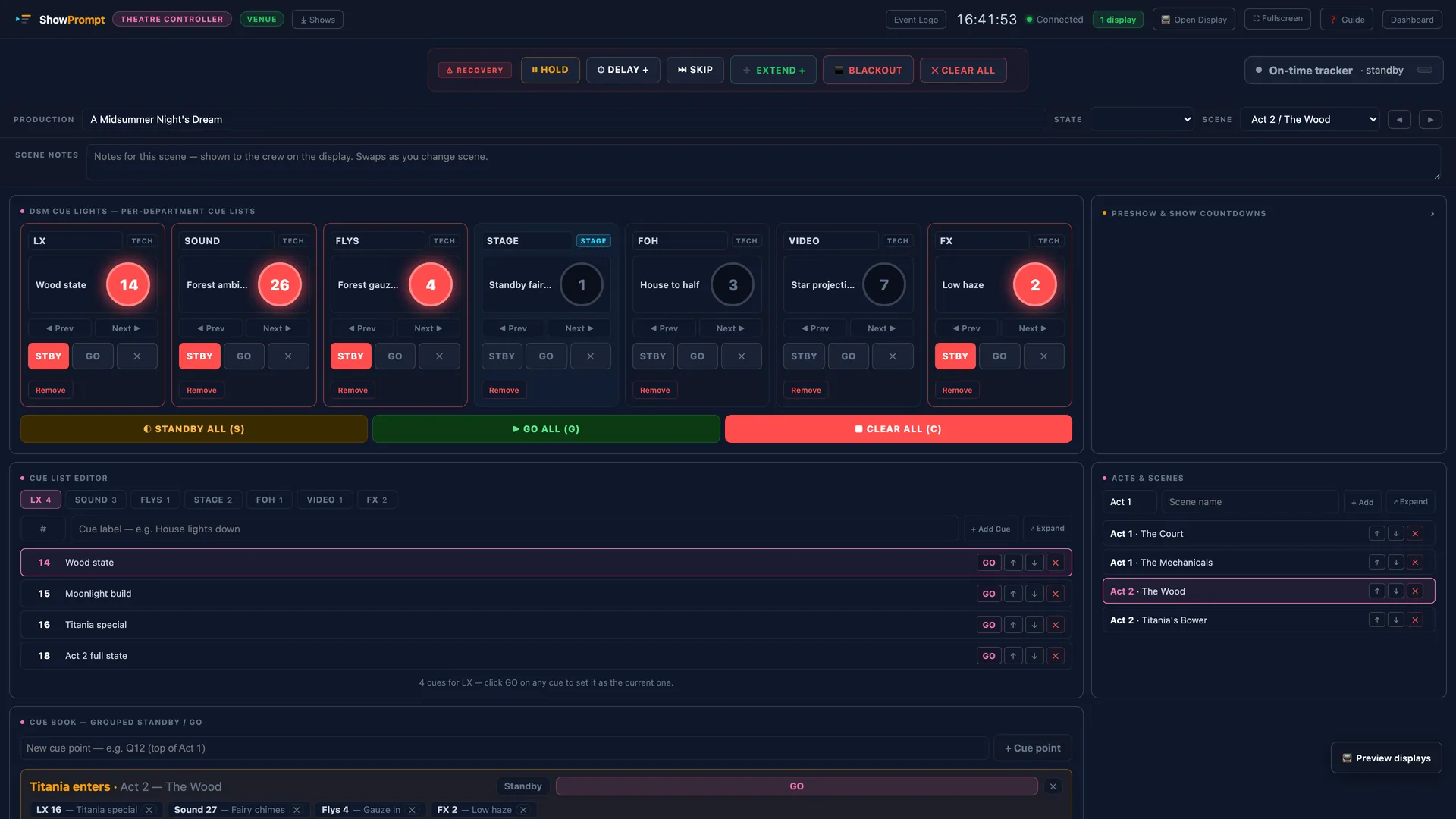
In theatre, the deputy stage manager's prompt book is sacred. It holds every cue, every standby, every moment marked against the script. The DSM "drives" the show from it — calling "LX 14, Sound 26… standby… GO" down the cans to each department. It's a craft refined over a century, and for good reason: it works.
But the paper prompt book has limits. Departments hear the call but see nothing. A new operator has to learn the DSM's rhythm. And a single complex moment (lights, sound, a fly cue and a haze hit all on the same beat) relies entirely on everyone reacting to a voice.
What a digital cue book adds
A digital cue book keeps the DSM in charge but gives every department a screen. When the DSM puts a moment into standby, each department's screen lights up with their cue number. On GO, every cue in that moment fires together and the screens show it. The voice call still happens, but now it's backed by something everyone can see.
Grouping cues into a single moment
The real power is grouping. A single point in the script — say, "Titania enters" — might call LX 16, Sound 27, Fly 4 and FX 2 at once. In a digital cue book you build that moment once, with all four department cues attached, and fire the whole group with one standby and one GO. No reading four separate numbers down the line and hoping everyone caught theirs.
Each crew sees only what they need
Lighting doesn't need to see the sound cues. With per-department theatre displays, the sound desk sees only sound cues, lighting sees only LX, video sees only video. The DSM sees everything. It's the prompt book, filtered for each seat in the building: less noise, fewer mistakes.
It doesn't replace the DSM
This is the important bit: a digital cue book doesn't automate the show or remove the human. The DSM still calls it, still feels the performance, still decides the exact instant of every GO. The screens just make the call clearer and give the crew confidence. Think of it as the prompt book gaining a voice on every department's monitor.
Why it matters for smaller venues
Big receiving houses have comprehensive comms and SM desks. Studio theatres, schools, amateur companies and touring shows often don't, and they're exactly where a clear cue book on a few cheap screens makes the biggest difference. A confident "GO" everyone can see turns a nervy crew into a tight one.