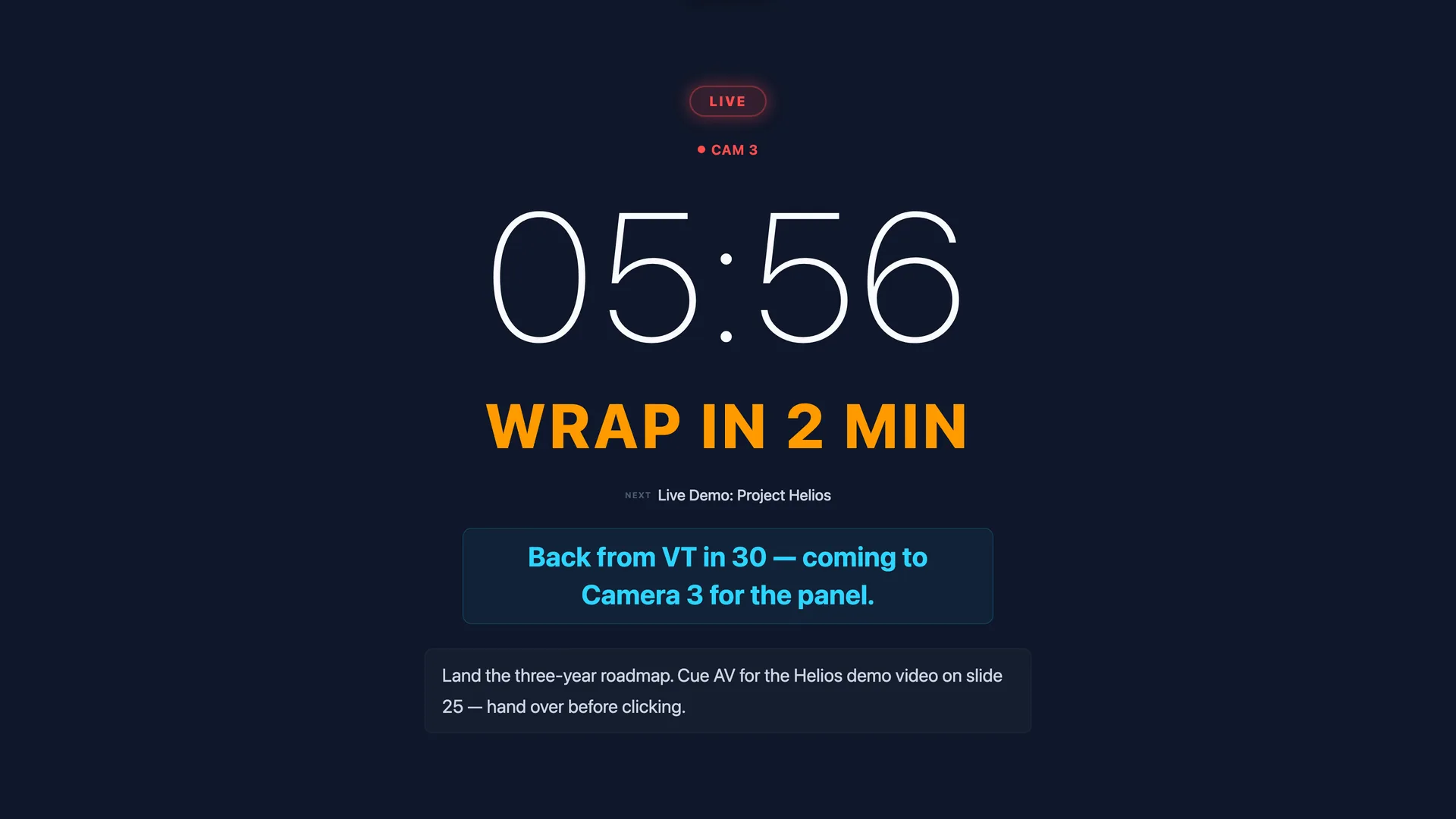
If you've watched a keynote, a church service or a TV broadcast, you've seen a confidence monitor in action — you just weren't meant to notice it. It's the screen facing the person on stage that tells them what they need to know while they're performing. Here's what it is and why it matters.
The simplest definition
A confidence monitor is a display positioned in the eyeline of whoever is presenting, showing information they need but the audience shouldn't see: a countdown, the current and next item, cue messages, and sometimes speaker notes or lyrics. The name comes from the confidence it gives the person up front — they always know where they are and what's next.
What it typically shows
- A countdown timer — how long is left in this segment, with colour warnings.
- Now & next — the current item and what's coming, so there's no awkward "what now?" moment.
- Cue messages — short instructions pushed live by the operator: "WRAP UP", "SPEED UP", "GO TO QUESTIONS".
- Notes or lyrics — speaker notes for a presenter, or the next line for a worship leader.
Who uses one
Confidence monitors aren't just for big TV studios. They're used by conference speakers, event hosts, worship leaders, theatre performers, and broadcast presenters. Anywhere someone has to perform to time and to a plan, a confidence monitor takes the mental load off them.
Confidence monitor vs teleprompter
People mix these up. A teleprompter scrolls a script over the camera lens so the presenter reads while appearing to look down the barrel. A confidence monitor is broader: it shows status and cues, not just a script. Many setups use both — a prompter for the words, a confidence monitor for the timing and cues. ShowPrompt's talent mode even includes a mirror-flip option for reflective prompter glass.
You don't need a studio budget
The myth is that confidence monitors require expensive hardware. In reality, any screen — a spare TV, a tablet on a stand, an old monitor — can be a confidence monitor if your software can drive it. With a local-network tool, the screen just opens a web page; the operator's laptop does the rest. That's how a one-person production can give their presenter the same confidence a broadcast gallery would.